Author: flyingpastaa

  • the last

    Pinion, Holly Warburton (2021)

    yesterday was the last day FS stayed in our shared apartment. 3 years, to an end. this weekend: the last of being in the same city as K, the last of living in this city i love so much. last month, two years ago, the first days of grieving that of who i loved most.

    the last is always bittersweet. at our age, it feels like the end of the world.

    i think about the colours of the lake, the last several months i saw it: Old Holland cerulean blue, some green peeking out; two days later, a moody slate blue; later, the blue it’s always been. i’ve looked at it every time i go downtown, almost as a game.

    i don’t remember the last time i got to speak to you face to face. i remember the last text i sent you. love stays just as impactful until the next, many people have told me.

    this is the last of everything. i love this place, but with the people having left, i realise now that the people truly do make the place. i do not have space to feel sadness after the loss of those who i have loved here in this city.

    i will always know this place, love this place, know these people, love these people. as time goes on, i may only know the past versions of these people, but it will be those versions that i love and that i cling to. i love you, don’t you see? didn’t you see? i will never forget you, and i hope you never do me, even if it has already happened.

    smoke swirls, the sun sets, the sun rises, the birds chirp – but the way i feel will never change. i will always be grateful for the versions of you that i got to know here, grew with here, left here. you are the eternal lover that chains me here. me, in my melancholy mind, in my inability to let go. i will forever cling to you.

    this house is not a home without you. this place is not a place that i love without you. what would i have done without you?

    every bit of you has seeped into me. packing up my favourite mug, my favourite plate, my favourite candle, my favourite room – you are steeped into every part of me, of where i consider home. i would not be me without you. i love you. i love you. i love you.


    this past weekend, i graduated from university. clearly, it is hitting me hard. it’s not necessarily an existential crisis – i know what i want to do and what i must to do achieve my goals after uni – but more so an inability to let go of what had become my present the last four years, and the people who have made it so. i’ve always been the sentimental type; i do not think this will ever change. i think this is a fundamental part of who i am. i’ve always been the first to come, the last to leave, and that has always been the most difficult for me. to my college roommate, who i have loved for the past four years and fused with for the past three in which we have lived together, i do not think i can separate my own self from you. to my best friend, who (fortunately) was able to move closer to me for the better of the past four years, i do not think i would be me without you. living without you in proximity will be my downfall. to the great love of my life, who i had the great honour of having for such a small fragment of this time; i will never forget. you, the time spent, the feeling of joy and safety by your side. to the friends i’ve made here, who i will never be able to not miss, who i will always think about. to the city i’ve truly grown up in, which i will always love. i love you all, equivocally, for the memories i have been lucky enough to make.

    everything has always been sentimental for me. i have never been good at letting go. unfortunately, this is not how things are supposed to go. we are supposed to grow together, move away, grow apart, grow separately. perhaps my most egotistical being refuses the notion that those i consider dearest can grow without me; regardless, it must be done. i love you. i love you. i love you.

    i have no words yet not enough for everything i have experienced here. this feeling is beyond wistful nostalgia. this is love i feel with every fiber, molecule, and cell within my body.

  • in the mood for love: two years

    still from In the Mood for Love, Wong Kar-Wai (2000)

    I recently just came across an Instagram reel suggesting romance films for different types of love. The creator separated love into three categories: love that hurts, love that’s fleeting, and love that changes you. For the last couple of years, whenever I’ve thought about love my immediate reaction brings me to think of one particular instance, one particular person. I think of this person and these memories fondly, appreciatively, and in a bittersweet light, but it wasn’t always this way. I would categorise this love of mine as love that changed me, though back when it was fresh it would have also fallen under love that hurts. When I think about it more, it was also love that was fleeting – while creating these boxes and categories to better put it into words, love does not need to fit into these compartments. In fact, it cannot.

    There’s a reason why such a high volume of culture (in music, writing, poems, etc.) follow or surround the subject of love. Love, as an emotion, is elusive and vague, yet everyone comes to understand it – or some form of it – at some point in their life. I also think that it doesn’t need to be a mutually agreed upon feeling, experience, or definition; love is what you decide it is, for better or for worse. When I was in middle and high school, I didn’t believe in love. My parents have always had a strange-but-typical-of-Asian-families relationship, in which it seems that they stick together out of obligation for their offspring and the peace of the family, but do not harbour genuine affection for each other (maybe once, but certainly not after I was born). This is what I grew up with as my blueprint for marriage, which was my equivalent for love. As I grew older, I believed that all relationships would end up like this. That love, marriage, was a chore. I’d always told myself that I’d only ever believe in true love if I fell in love.

    And then I did. Although, now that it’s been eight years, I can accurately analyse and determine that while the love I felt was platonic, possessive, intense, unique – it was not romantic love. At the time, for someone who was 14 years old, it was simply novel. Now, though? Thinking of love, I think of my family, K and J and FS and A, my other friends, all the cities and countries and streets I’ve fallen in love with.. but most frequently, I think of JM (for the sake of ‘privacy’, not that anyone reads this, even the initials have even been changed).

    I would consider JM to be my “first love”; this will be someone I tell my children about, that I tell every new person I meet about, that I will remember. It only took me about a month to fall deeply, wholly, consumingly in love with him – which, for me, was shockingly fast. It felt violating, in a way. Am I that fickle with my feelings, I thought? Am I this easily convincible, do I have such low standards, I thought? No, I know the truth, I know the kindness, the attentive behaviour, the consideration, the smiles, the gentle teasing, the this song is my new favourite, I think you’ll like this one, and the whats your day looking like? do you have time in the evening?, the I’m not free until night but are you okay, I can come now for thirty minutes if you need me? The gentle caring that brings tenderness and tears – fit like two puzzle pieces, a key in its lock. Belonging. Rightness. My best friend.

    Once, in one of the many nights we would stay up to do “work” together, I vividly remember: me, laying on the floor. Him, sitting on the piano bench. Legs caging mine, feet pressed tightly like sardines in a can. New Daniel Caesar album playing. Always.

    “Do you want kids?”

    “Yeah, I feel like I’d get bored in my marriage without them. The change would be good, right?”

    What? Why do you feel like you need change? You should be marrying your best friend.. as in, every day you’re able to make each day exciting and fun and novel. Why would you want a change?”

    Of course, this is an abridged version of the conversation, but the gist is there. From then on, I changed my mind about the necessity of having children for the sake of my relationship, because I agree. And mostly, because in that moment in time, laying on the floor underneath the Steinway piano, with my feet pressed between yours, I realised that in a life which I spent with you, my best friend, by my side – I wouldn’t seek out any change. The great love of my life, my best friend, made for me, made for me, my best friend, my best friend. All words, no words, nothing is quite enough to describe this. Young love? Perhaps. Perhaps music, perhaps scents, perhaps flowers – but no words. No words to describe this, to describe you.

    There are no words to describe the feeling in the days after, the way I could barely breathe, removal of one of my lungs; maybe I became too dependent, maybe I relied on your constant presence too much, maybe I felt the immense, yawning absence of a friend I considered closer than all others. Everything was you, and suddenly you were in everything, and I hated it. It was then I think I understood that love could also maim you just as much as it could construct and heal you. It was also then I realised that some loves could also be as ephemeral as the bloom of irises. At one point, it was indistinguishable to me where you ended and I began. It was then you wove yourself into the fibers of my own self, I think. I am not me without you, both with and without the bliss and the torment. I hope I always remember you, what you’ve done for me, what I was like with you, and what you were like with me.

    To be loved, not like a habit, not like a chore, but more like the way I loved you, the way I love you, the way I cherish you. To be loved like one who is always in the mood for love.

  • you can’t have it all

    Solitude, Edward Hopper (1944)

    Today, the lake is a beautiful eggshell blue. At least, it was earlier this morning, viewed in passing while commuting to my boxing class.

    Boxing is a newer ‘hobby’ of mine that I’ve been trying to implement more frequently in my routine life, especially as the aggressive physical activity is effective to quell my anxiety, and in general has been an easier form of cardio to complete than my usual runs. With running, I go through bouts of loving it, needing it, and hating it. Right now, I am in a place between hating and needing it. Yesterday I went on a run – 4 miles, the first run over a mile that I’ve gone on since October of 2024 – and it was an incredibly difficult experience for me both physically and mentally. Physically, because I had been stupid and not hydrated or ate beforehand and in recent months am not used to running longer distances. Mentally, because I knew I was out of shape, and the farther I ran away from my apartment, the more I wanted to give up and spend double the time walking back. Evidently, I do not have a winner’s mindset. It was introduced into my life back in late elementary school, when I was competitively swimming and was required to run for dryland and endurance exercises. This fed into middle and high school, when I switched sports to field hockey (mildly regrettably, though this is a whole other conversation) and that is obviously a sport that revolves around running. For the next 5 years of my life, running became both a daily yet dreaded obligation.

    This changed during COVID, when suddenly school switched online and I was stuck at home like everyone else. Also around this time, I experienced by first (pseudo) breakup with someone who I was exceptionally emotionally dependent on as an insecure, validation-seeking teenager. These two events coinciding resulted in the feelings of restlessness of a young athlete suddenly being restricted from an active lifestyle, and those of a young girl craving an outlet for the horrible emotions carving up her insides. From then on out, I began to run as a religion: every day, awake at 5:30a.m. on the dot, out the door at 5:45, the following 60+ minutes running laps around an empty riverbed near my neighborhood. I treated this sacred routine as if I were its most devout disciple, yet I simultaneously offered myself zero grace. For the next year, running became both a lifeline and self harm.

    Running is not the only activity in which I have developed a hyperfixation for over the course of my life thus far. I am, after all, an irrefutably selfish, obsessive, and volatile person. At my younger ages I loved video games, but developed some parasocial tendencies that reflect my obsessive side. I had my dad (who spoiled his only daughter) purchase every single Pokémon game from Gen IV on and would play them under my blankets in secret until I finished the game in one go, resulting in a current-day prescription of over -6 in both eyes. I also loved reading and drawing to the point of developing strong feelings about certain series and characters, and spending late into the night (unhealthily, for someone at that age) drawing and drawing and drawing. My mom thought this was the result of a creative mind and enrolled me in art classes that met for three hours a week. Frequently, I would elect to “double” my classes and spend 6 hours straight sketching or painting, forgetting to take breaks to stretch or eat. My mom also started me on piano lessons since around age 4. Whenever I would feel particularly sad, or frustrated, or anything extreme at all, I would play for hours on end. Most of the time, I would only play the same 5 or so measures of one piece for the whole duration of this time. My parents would get frustrated with the repeated soundtrack and make me stop. As I got a little older, whenever I read a book or watched a TV show I had to finish it all in one sitting (or two, if the TV show was long enough).

    As if my obsessive mannerism towards my “hobbies” already didn’t sound unhealthy enough, it became worse one day when I began attending the middle-high school that I would eventually graduate from. Around this time, I promptly dropped almost all of the aforementioned activities and classes, and began devoting myself instead to schoolwork. In seventh grade, no less, as if there was much work to put in back then to begin with. I didn’t let myself read recreationally, or watch TV, or play video games; I quit both my piano and art lessons, I never arranged to hang out with friends outside of school, I had a teacher set the time limit password on my phone for certain apps. It’s difficult to pinpoint exactly why this radical switch happened; maybe it’s because my school environment was toxic, maybe it’s because I’m inherently hard on myself, maybe it’s because I’m a perfectionist. Maybe it’s a combination of all of the above. Regardless of the cause, the effect was profound and, honestly, quite disastrous. For someone who was barely 13 to be hating themself that much – it’s not something that anyone should go through, at that age or (really) any other.

    It’s also not something I’m fond of elaborating on, or quite frankly am capable of (I think bits of those 6 years have been blocked from my memory, so accurate recall is difficult). It is, however, an experience in time that has largely shaped who I am now; all the good, and all the bad. It’s also interesting for me to reflect on the stages of my life up until now, and especially right now, since.. recently, I actually have no desire to do anything. For someone who has spent 95% of her life being compulsive and addicted to whatever it was she could get her hands on, this current me is like an alien inhabiting my body. And once again, it’s due to reasons I can’t pinpoint or explain. Maybe academic burnout, maybe an existential crisis, maybe mental weakness, maybe self-pitying, maybe option D: all of the above. I tried reading The Bell Jar the other day, since it’s such a Plath classic and I thought internalising the famous fig quote in context might help me out of my slump. I could only get through around 70% of it before I had to stop. Not because it was bad or a hard read – it was beautiful, and insightful, and everything I could want in a book – but because it ended up nearly setting off a massive anxiety attack. So I stopped reading it.

    All I can hope for is that this time is transient. That when I move to the UK in 5 months, the new life and novelty of it all will be enough to jumpstart my nervous system. That by reminding myself you can’t have it all every day, the pressure placed on me by me will lessen, and my lungs will once again have room to inflate and my chest to expand. For now, all that’s left is to keep sketching that easy movement seen in others instead, to keep getting lost in fictional worlds and in translation, and to keep chasing the sky to where it meets the water.

  • people you meet

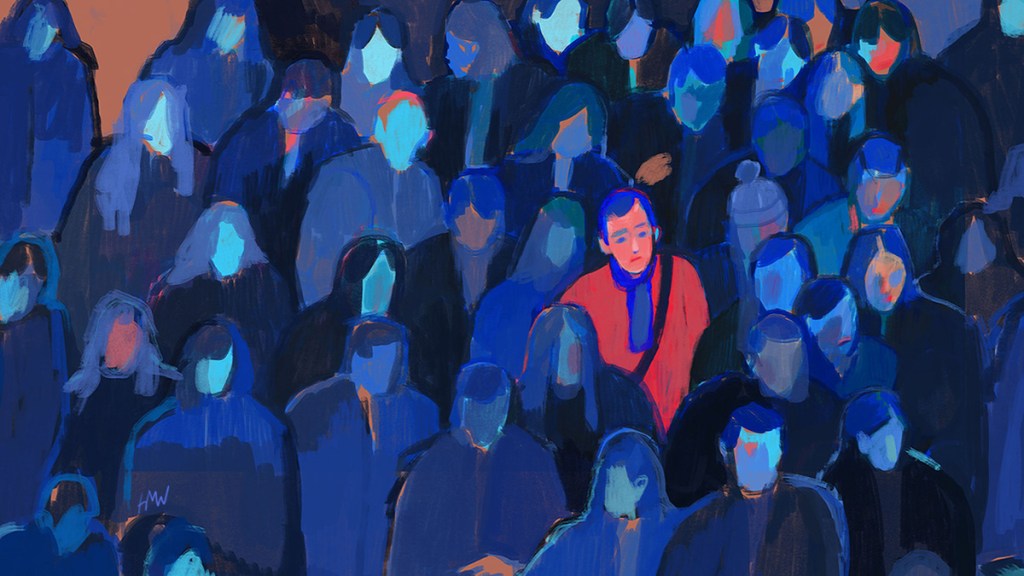
    A Face in the Crowd, Holly Warburton

    Out of all the people in your life, save your family, who contributed into making you the most you?

    I think about this often, but not framed exactly in that manner – for example, I often think about how everyone in my life knows of K and hears me talk about her all the time. In the same way, most of my friends also know about J and A. I believe knowledge of the existence these three people play in my life is essential to understanding me as who I’ve come to be today. But I don’t necessarily think my whole past is restricted to these three people; to my knowledge, all those closest and most important to me know a total of 11 people in my life, 7 of whom have shaped me positively. The remaining 4 also have significantly impacted my past, albeit negatively..

    I was curious as to whether other people feel similarly to me (as in, also have key foundational figures in their life), and asked some friends. Here’s what K said:

    Which, after asking ES and SH and compiling my own answer into the mix, makes sense. The reason why her number kept increasing is because, after further consideration, we both decided that those who had had negative impacts still counted into the mix. I think the prompt can be easily misunderstood at first to be something more along the lines of, who are your friends that you cannot live without?, which makes it much easier to assemble a list of people that likely exceed the range of 5-10ish. I wouldn’t consider that interpretation of the question “incorrect,” though; I think it just goes to show that people are able to think of many others that they cherish in their lives quite easily, causing the numbers to stack up. However, I think it is also important to recognise that even if there are people from the past who you’ve had terrible, heartbreaking, horrifying experiences with, those events still make up a part of you and thus also require them to be counted into the mix.


    Chuck Palahniuk – author of Fight Club – wrote in his book Invisible Monsters:Nothing of me is original. I am the combined effort of everyone I’ve ever known.” This quote has been reconfigured into so many variations, but the general idea has persisted, the idea that you are made up of bits and pieces of everyone else surrounding you. Personally, I’ve always found this to be true, whether it shows in little daily mantras or sayings you pick up from friends, or your adjusted coffee shop order after countless mornings with a partner, or your night owl routine slowly morphing into one of an early bird. And isn’t it beautiful? To discover individualism is sourced not from one soul, but countless? That, by philosophical definition and long thought, such a thing may not even exist?

    Through the years, I’ve grappled through thoughts of my own stubbornly insisting on a life of self reliance, of polarising independence – something that manifested in self-imposed isolation, at times – but it’s times like these, thinking about the people who make me up, who make us all up, that I can both appreciate and accept the inherently social, dependent, and deeply intertwined nature that subsists as humans.

  • 04152025

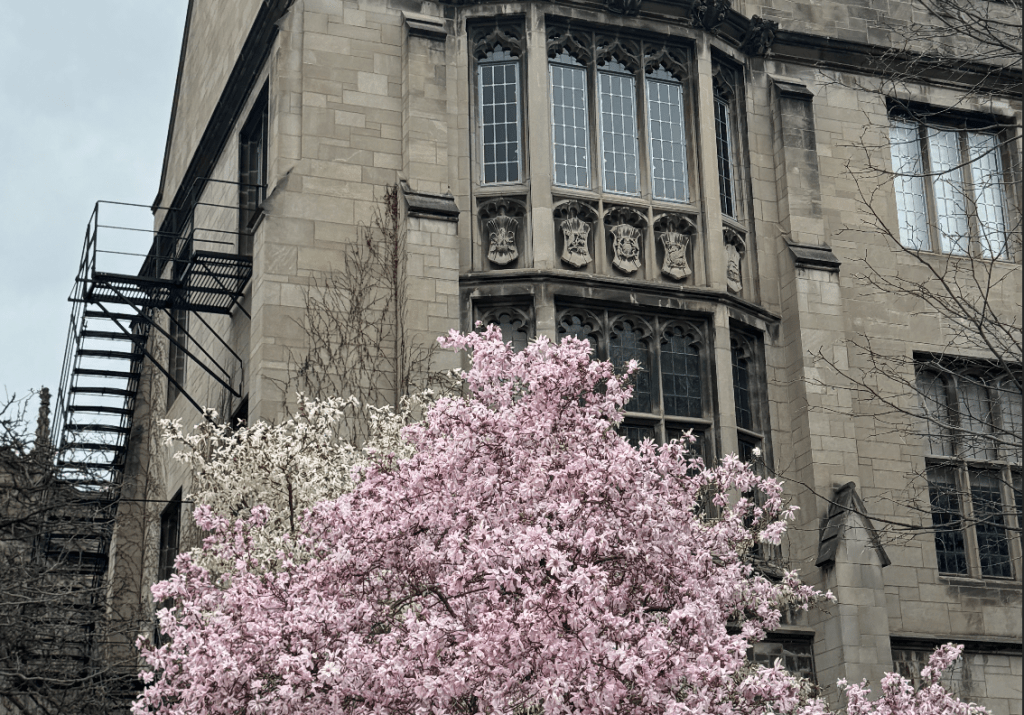
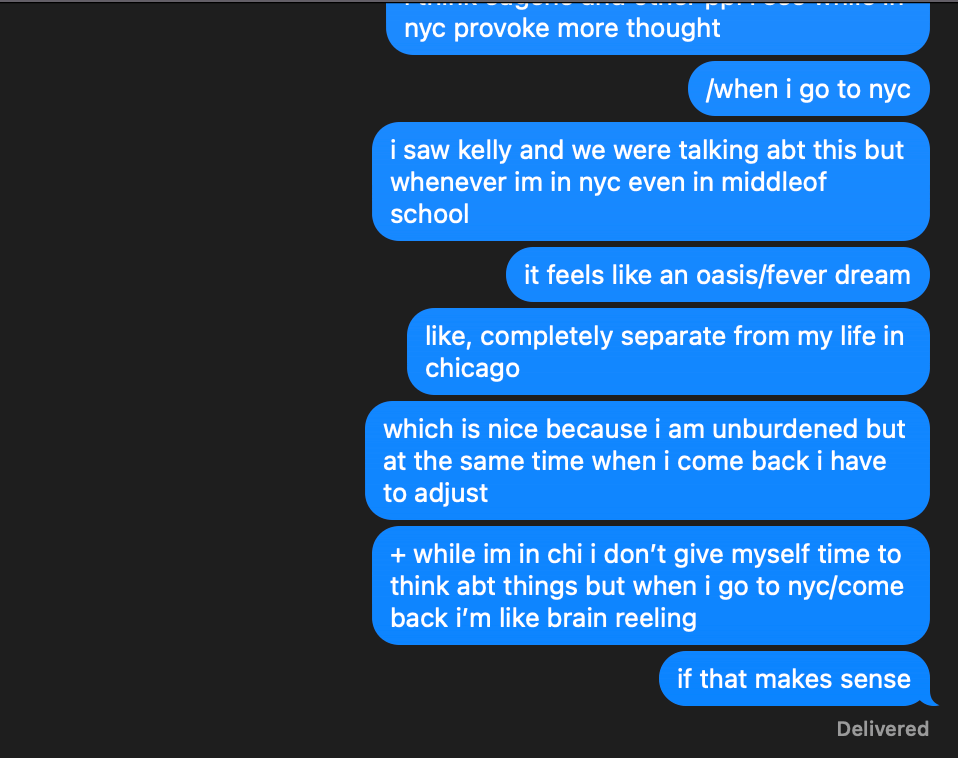
    I love Chicago, I love magnolias, I (have a) love (-hate relationship with) spring, April. The city that I grew up in, that’s become home – I’ll always be here, comfortably, safely. At the same time, I know that my time here is marked by dates; my quarters, which are 9 weeks (10 including finals) are split into deadlines, which makes time accelerate much faster. While my entire life is here – all the people I feel closest to, the tasks and miscellaneous things that give me meaning, the landscapes that I understand – I feel, all the same, that my life is suspended in time while in Chicago. Very rarely do I ever get, or give myself, an opportunity to stop and think about what I’m doing, what I’m working towards, what I feel; as someone who’s grown up around people that, and who herself, values deep introspection and intentionality around their thoughts, words, actions.. this way of life has become frighteningly too easy for me to adapt to. To put a damper on such profound feelings that were so highly revered in earlier years of my own life is terrifying; perhaps that’s why I am able to appreciate so my time in New York.

    texts sent to ES reflecting on this topic

    I do love New York – the novelty, the sounds, the people, the chaos. At the same time, I despise New York for the same reasons. This feeling resides on such a delicate scale, and I think each time I’ve gone back my resulting perspective has significantly altered; for example, after this trip, I think I love New York, but just last year this time, I disliked it. The way I love Chicago exists in a completely different realm – while I also attribute pieces of myself to New York, am familiar enough with certain areas, have many fond memories – my highest highs have always been in Chicago, and some of my lowest lows also call this city home.

    Yes, people I’ve met in New York I’ve come to call home, but all the same, the people I’ve met in Chicago are so thoroughly and sufficiently become engrained in me that I cannot fathom thinking of myself as an individual without their influence.

    New York allows me to breathe, to think, to simply be – Chicago is the source of my contemporary self, and there’s nothing I would do to change that. Love, after all, does not begin or end in the way we think it does. Silent understanding, acknowledgement, sharing, forgiveness.